
An evocative itinerary
We suggest an evocative itinerary, without listing the places you can find on any beautiful postcard: we will take you to discover magical and mysterious places (the name Napoli Leggendaria is no accident).
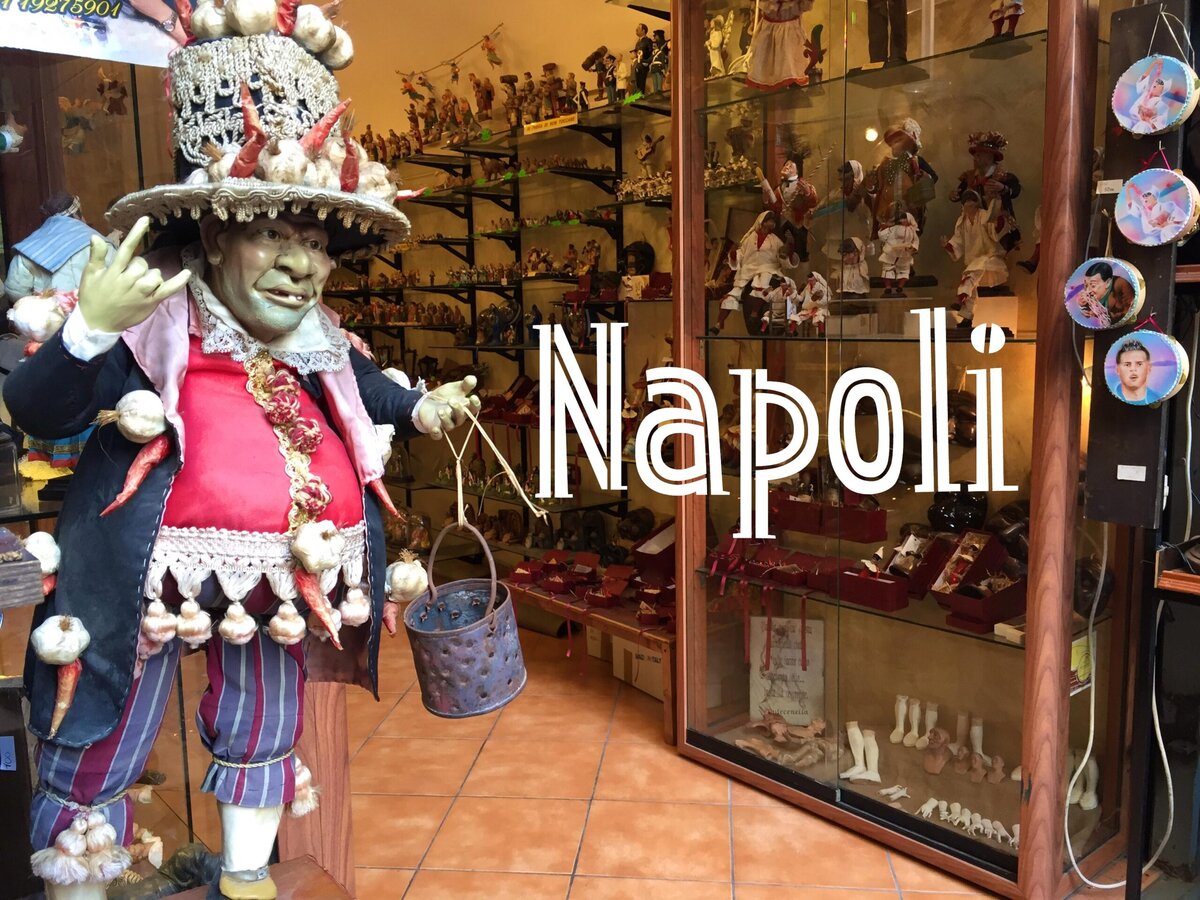
Given its location, the B&B Napoli Leggendaria is ideal for tourists who want to discover the main monuments of the historic centre without using any vehicle or, if you prefer, using public transport for very short stretches.
Markets (we will give you all the information and more), the underground (breathtaking), hidden corners of the sea, mysterious corners of the city, traditional workshops, the settings of famous films, philosophies of life, sublime popular cuisine (there are places a human being cannot imagine) and much, much more: let yourself be carried away by the intoxicating royal city. Napoli Leggendaria is waiting for you.
Stop 1: The Fontanelle Cemetery
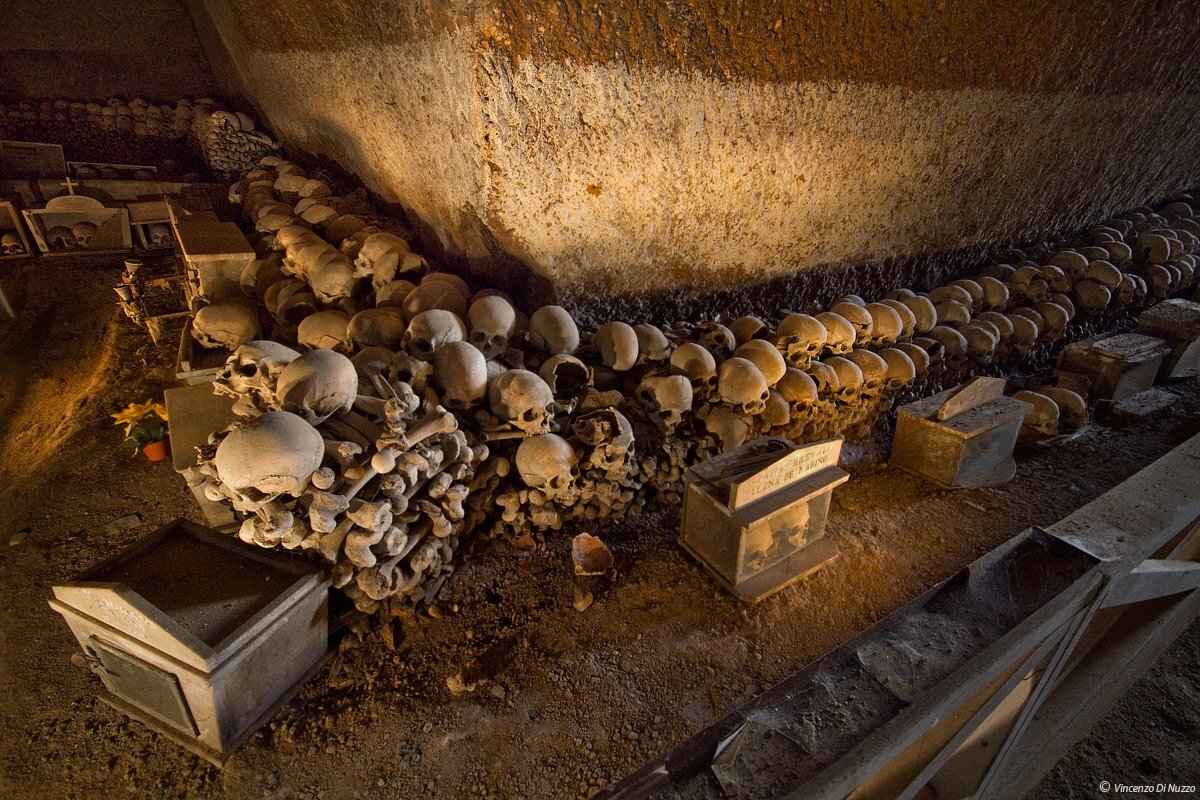
In Neapolitan ’O Campusanto d’ ’e Funtanelle, it is one of the most evocative and mysterious places in Naples. The cemetery, so called because of the water springs once found there, is carved into the tufa rock and is entered from the church of Maria Santissima del Carmine, in the Sanità district.
The origin of this sacred place probably dates back to the 17th century, when the population of Naples was decimated by the plague and the cemetery took in the victims. Linked to this cemetery is the cult of the “anime pezzentelle”, the anonymous bones and abandoned souls adopted by devotees, who dedicated rites and attentions to them in exchange for help and good fortune.
Stop 2: Basilica of Santa Maria della Sanità
Built between 1602 and 1613 by the Dominican friars to a design by Fra’ Nuvolo, this Baroque church stands in the heart of the working-class Sanità district. The building has a dome covered in majolica tiles, a Greek-cross plan inscribed in a square and a singular volumetric layout marked by 24 pillars, chapels and small domes.
The interior is rich in paintings by Luca Giordano, Andrea Vaccaro and Agostino Beltrano and in marble and stucco decoration. A double flight of marble stairs leads up to the high altar, where there is a fine carved wooden choir. From the presbytery you reach the Catacombs of San Gaudioso, an ancient burial area from the early Christian period.
Particularly unusual is the elliptical cloister, with pillars, upper arches and decorations depicting episodes from the lives of the Dominican friars. The layout of the small cloister was, however, upset by the opening of Corso Napoleone in 1810, which crossed the Sanità valley on a bridge, one of whose piers intruded into the space of the cloister below.
Stop 3: Palazzo dello Spagnolo
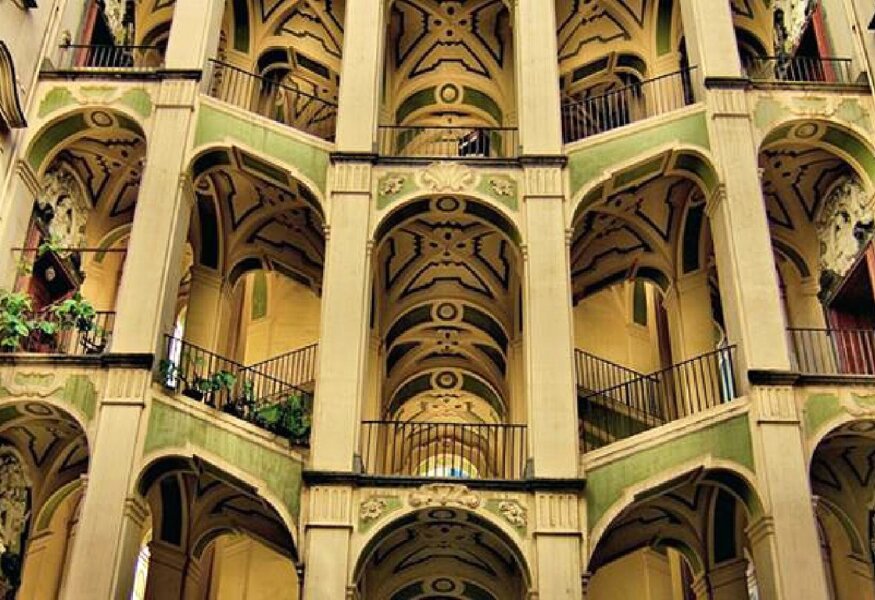
The palace was built from 1738 at the behest of the Marquis of Poppano, Nicola Moscati, who joined together two earlier buildings received as his wife’s dowry. The design is traditionally attributed to the architect Ferdinando Sanfelice. The building is known for its original internal staircase, called “ad ali di falco” (hawk’s wings). Interior and exterior were richly adorned with distinctly Rococo stucco decoration, created by Aniello Prezioso to a design by Francesco Attanasio around 1742.
The doors to the apartments are topped with stucco overdoors, with medallions bearing portrait busts at their centre. At the end of the 18th century the palace was rebuilt and enlarged with an additional floor. At the beginning of the 19th century the family was forced to sell the apartments on the first and second floors. The new owner, Tommaso Atienza, known as “lo Spagnolo” (the Spaniard), who gave the palace its name, had the rooms frescoed; these frescoes are now almost entirely lost. Numerous films have used the palace as a backdrop, one of the most recent being John Turturro’s “Passione”.
Stop 4: Palazzo Sanfelice
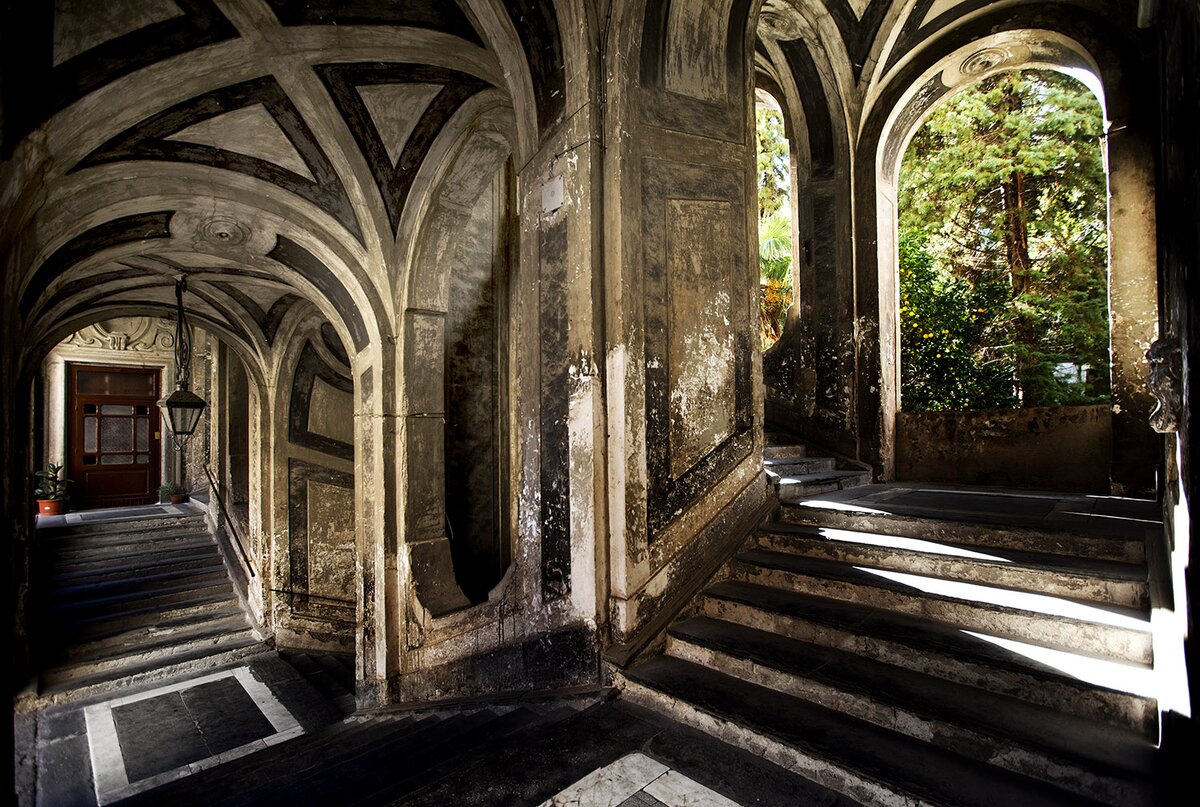
Palazzo Sanfelice is a monumental palace in Naples, in the Rione Sanità. Between 1724 and 1728 Ferdinando Sanfelice designed his own home for himself and his family in an area outside the city walls, a healthier place than the overcrowded centre. Sanfelice designed the palace next to an existing building the family had bought, which was incorporated into the project for his majestic residence. On the twin portals in piperno and marble are 18th-century plaques between the sirens and the first-floor balcony.
The stairs at the entrance have treads covered with slate, added by Sanfelice in honour of his wife, who came from the town of Lavagna in Liguria. The first courtyard, with its famous open staircase, was used as the setting for the film Questi fantasmi, the screen adaptation of Eduardo De Filippo’s play Questi fantasmi!
It has also been the setting for other films, such as Nanni Loy’s Le quattro giornate di Napoli and Pasquale Festa Campanile’s Gegè Bellavita; in September 2011 scenes were shot here for the mini-series Pupetta – Il coraggio e la passione with Manuela Arcuri, first broadcast in June 2013. In the third act of Roberto De Simone’s La gatta Cenerentola, the set is inspired by this palace.
Stop 5: The Catacombs of San Gennaro
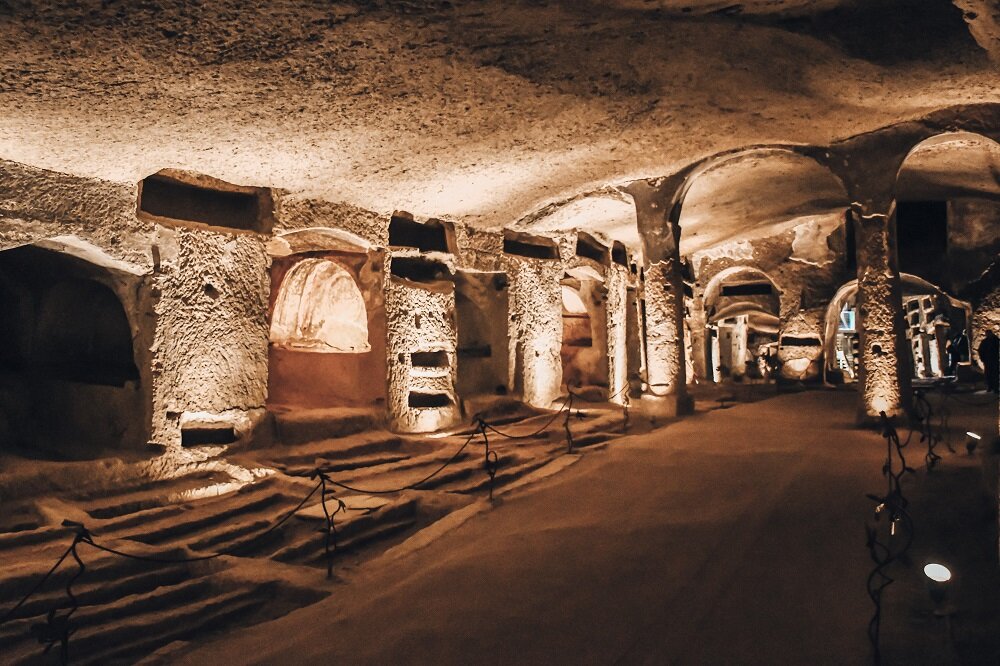
The Catacombs of San Gennaro are the most important in southern Italy for their size and their historic and artistic value. They consist of two non-overlapping levels following a wide, horizontal, shallow excavation scheme, for a total of 5,600 square metres of walkable space. The artistic layering is clear and striking: the rooms, decorated with frescoes and mosaics, date from the 2nd to the 6th century AD.
Particularly beautiful are the “lower vestibule”, a veritable underground city, and the “Basilica maior”, a three-nave underground basilica carved into the tufa and dedicated to the ancient cult of the patron saint of Naples. The latter preserves numerous frescoes from the 5th–6th century AD.
Book your stay in Naples
Tell us your arrival and departure dates and we will check the availability of our rooms.