

A fiery sunset over the Bay of Naples, with Vesuvius on the horizon

Neapolitan legends

In Neapolitan popular culture, legends and their mysterious characters have always held great importance. This is the reason behind the name Napoli Leggendaria, “Legendary Naples”, which also highlights the city’s legendary excellence in all fields of art and culture.

The silhouette of the siren Partenope in the water at sunset, in front of Vesuvius

I

Partenope

Homer tells that Ulysses, a cunning but extremely curious traveller, knew how dangerous the sirens were: they lured sailors with their angelic, flattering song and then killed them ferociously. So when the hero of the Odyssey passed through their land, an island off the coast of the Sorrento peninsula, he gave his crew wax earplugs but had himself tied, with no protection at all, to the ship’s mast, ordering that he should not be released for any reason, even if he begged.

And so it happened that the siren Partenope, shattered by the Greek hero’s rejection, killed herself by throwing herself into the sea. Her lifeless body was found and lovingly gathered by the ancient inhabitants of Naples on the islet of Megaride where, for all of us today, the famous Castel dell’Ovo stands.
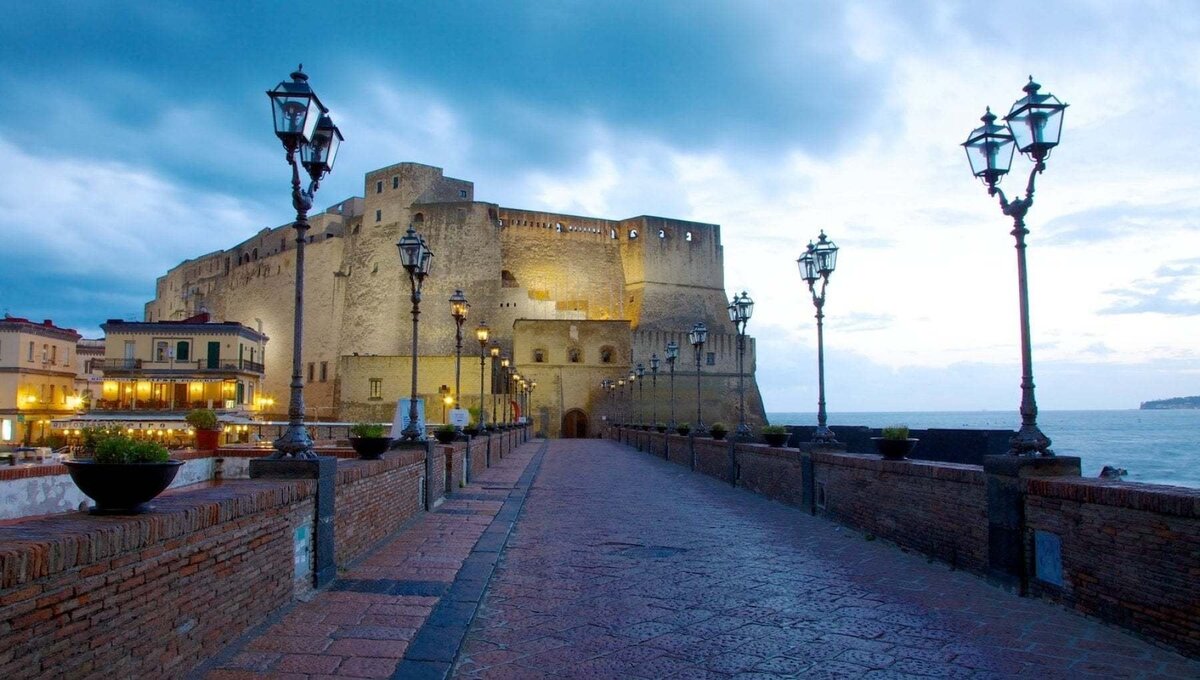
Castel dell’Ovo at dusk, seen from the seafront with its street lamps

II

Castel dell’Ovo

The name “Castel dell’Ovo” (Castle of the Egg) comes from an ancient legend according to which the Latin poet Virgil, who in the Middle Ages was also considered a magician, hid in the dungeons of the building an egg that held up the entire fortress. If it broke, it would cause not only the collapse of the castle but also a series of ruinous disasters for the city of Naples.

The legend was already circulating in 300 AD: the egg was said to have been placed in a glass carafe full of water, protected by an iron cage. This was hung from a heavy oak beam in a small chamber in the castle’s vaults. So far, nobody has found the egg.

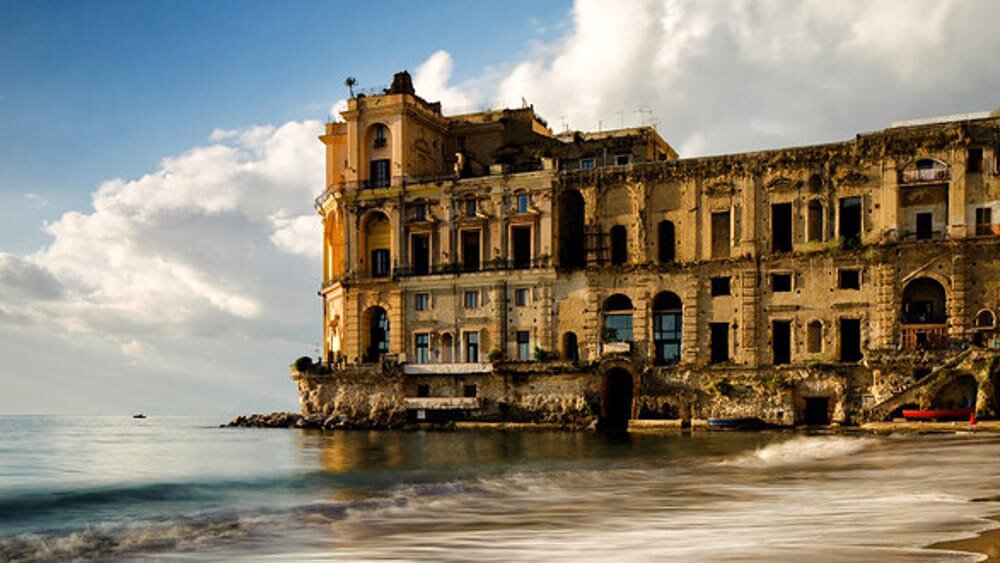
Palazzo Donn’Anna overlooking the sea at Posillipo

III

Palazzo Donn’Anna

According to the legend told by the writer Matilde Serao, Donna Anna Carafa, wife of the Duke of Medina Coeli, loved to organise magnificent receptions attended by all the Spanish and Neapolitan nobility. At one of her many parties, the very rich, powerful and feared Donna Anna had a small theatre set up for a play whose actors, in keeping with the French fashion of the time, were all nobles.

Among them was the beautiful young Donna Mercedes de las Torres, the duchess’s niece, who played a slave in love with her master, played by Gaetano di Casapesenna. The two acted with such passion that in the final scene of the kiss everyone applauded with enthusiasm, everyone except Donna Anna, who turned pale, consumed by jealousy at the sight of her lover passionately kissing the young Mercedes.

In the days that followed the two women clashed violently, and then Donna Mercedes suddenly and mysteriously vanished. Word spread that she had taken refuge in a convent after a sudden religious vocation, but poor Gaetano searched for her desperately and without rest, prayed, begged and wept all the tears he had, until he died in battle. Jealousy had poisoned Donna Anna’s soul, and that bitterness never left her, to the end of her days.

According to this legend, from time to time the ghost of cruel Donna Anna appears in the palace, along with the presences of the two unfortunate lovers, Mercedes and Gaetano, who forever search for each other in despair.

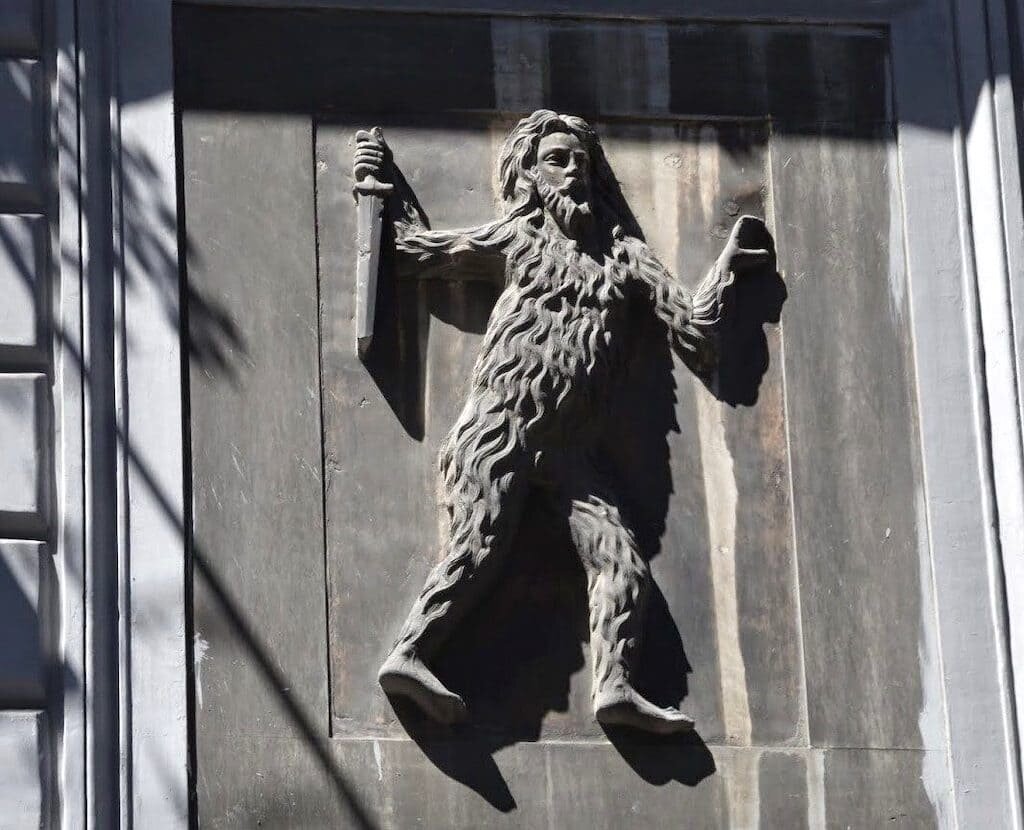
The bas-relief of Colapesce: a man covered by a skin, with a knife in his hand

IV

Colapesce

In Neapolitan tradition, Cola (Nicola) Pesce, or Pesce Nicolò, is a boy cursed by his mother for his constant diving. He ends up turning into a fish himself and growing scales. Cola sought refuge in the sea, using the bodies of large fish, letting them swallow him and getting out on arrival by cutting open their bellies.

The legend originates in the late pagan cult of the sons of Neptune, that is, divers endowed with magical powers, able to hold their breath underwater in order to seize its treasures and secrets. By mating with mysterious sea creatures (probably monk seals) and with the help of the siren Partenope, they acquired these magical powers. The late pagan origin of the legend is recorded by Benedetto Croce in Storie e leggende napoletane.

A bas-relief depicting a man covered by what looks like a skin, with a knife in his hand, the weapon used to get out of the belly of the fish that carried him, can be found in Via Mezzocannone, in the university district. In 1936 Raffaele Viviani dedicated a poem to him.

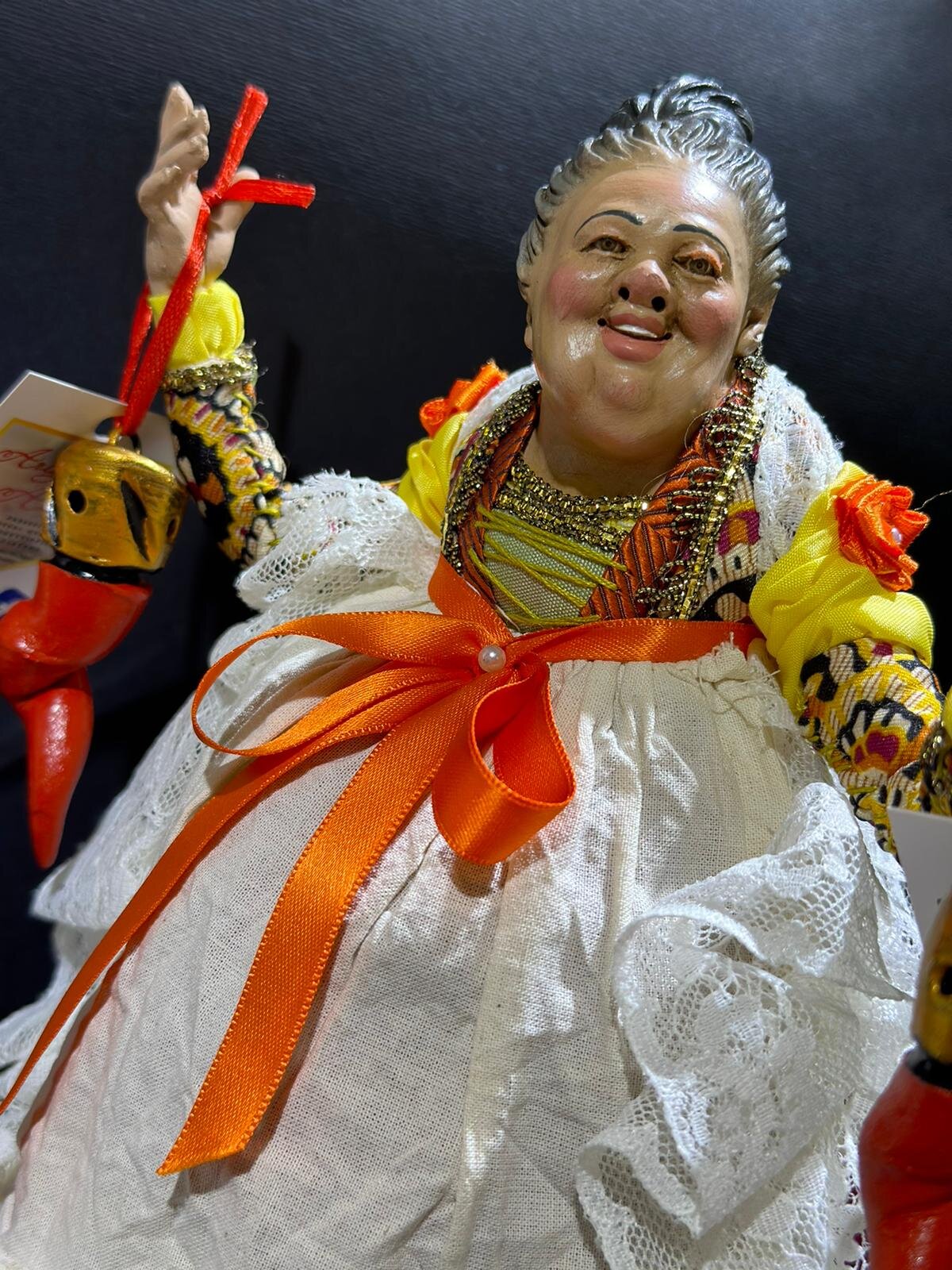
A figure in traditional Neapolitan costume, in a white dress with orange ribbons, smiling with raised arms

V

Bella ’Mbriana

Tradition tells of a beautiful princess, as beautiful as she was unhappy, and of a love she never lived. A love so strong and absolute that, once lost, it left an absolute emptiness inside her. So boundless was her despair that her reason could not bear it; the young woman lost her mind, and her madness led her to wander the alleys of the city like a shadow, searching for something or someone she never found.

The king, her father, in despair and not knowing what to do, decided to protect her by anonymously rewarding those who, moved by her unhappiness, opened their homes to his poor daughter. And so the legend was born of a mysterious female figure who dwells in our houses and protects them. For the people of Naples she is the Spirit of the house, and she brings well-being and health to those who live there.

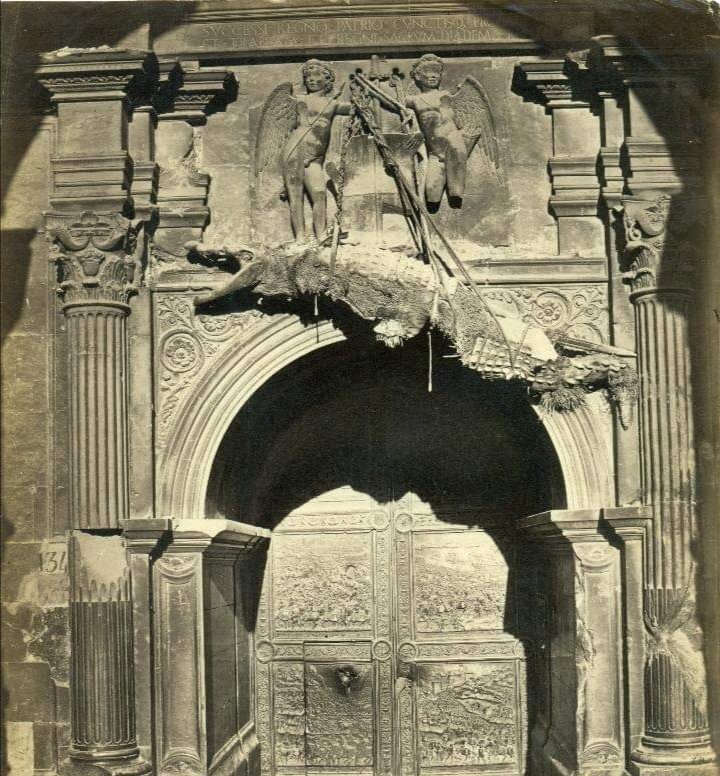
The carved portal of the Maschio Angioino in an old photograph

VI

The Crocodile of the Maschio Angioino

An ancient legend tells of frequent and mysterious disappearances of prisoners, which led to increased surveillance. It was soon discovered that these disappearances were the work of a crocodile that came in through an opening in the dungeon and, after biting the prisoners, dragged them out to sea by a leg.

Once this was discovered, all the condemned who were to be put to death without too much fuss were thrown to the reptile’s jaws. Later, to kill the crocodile, a large poisoned horse’s leg was used as bait and, once dead, the animal was stuffed and hung over the castle’s entrance gate.

Book your stay in Naples

Tell us your arrival and departure dates and we will check the availability of our rooms.